Nickel-based Cast Superalloy: Properties, Applications and Manufacturing Processes
Nickel-based cast superalloys are the material backbone of the hottest gas turbine stages: turbine blades, nozzle vanes and integrated vane clusters are investment-cast from them because their geometry — thin airfoils, internal cooling channels, film-cooling holes — cannot be forged or machined economically. The nickel gamma matrix, strengthened by coherent gamma-prime (Ni₃(Al,Ti)) precipitates and refractory solid-solution additions, retains usable strength, creep resistance and oxidation resistance above 700 °C for thousands of hours. Casting is not a fallback route here: it is the only practical way to build these shapes, and the casting route itself decides most of the final mechanical behavior.
The Core Casting Decision: Equiaxed, Directionally Solidified, or Single Crystal
Cast superalloy buyers face one structural decision before any other: what grain architecture the part needs. It is a property-versus-cost trade, not a default.
| Attribute | Equiaxed Cast (EQ) | Directionally Solidified (DS) | Single Crystal (SX) |
|---|---|---|---|
| Grain structure | Random fine/mixed grains | Columnar grains along one axis | One crystal, no grain boundaries |
| Creep resistance | Baseline | +Improved (no transverse boundaries) | +Highest (boundary-free) |
| Thermal fatigue | Good (fine grains) | Moderate | Reduced at high temp, sensitive to defects |
| Castability & yield | Best, cheapest | Intermediate | Most difficult, lowest yield |
| Typical use | Nozzle vanes, shrouds, moderate blades | Blades, vanes under unidirectional stress | High-pressure turbine blades, hottest stages |
The rule of thumb: use EQ where cost and complexity dominate, DS where load is unidirectional and high, SX where metal temperature approaches the alloy’s limit. Selecting SX for a lightly loaded vane wastes money and yield; selecting EQ for a HP turbine blade risks premature creep failure.
The Casting Route in Stage Gates
- Vacuum primary melting — VIM melts the charge under vacuum, controlling chemistry and removing oxygen, nitrogen and hydrogen; the melt becomes master ingot or electrode.
- Secondary refining — ESR or VAR remelts for homogeneity and inclusion control; premium aerospace lots require this step for consistent properties.
- Wax pattern & shell — the airfoil’s wax pattern (with cores for cooling passages) is assembled on a sprue, dipped in ceramic slurry and stuccoed into a shell, dewaxed and fired.
- Pour & solidification control — molten alloy pours into the preheated shell; for DS/SX, a withdraw furnace maintains a steep thermal gradient so grains grow (or one crystal survives) along the pull axis. Solidification rate and gradient set the final structure.
- Knockout & cleaning — ceramic shell and cores are removed by mechanical and chemical means; cooling-channel cores must be fully removed.
- Heat treatment — solution treatment homogenizes and dissolves unwanted phases; aging precipitates gamma-prime at target size and volume fraction. Parameters are grade-specific.
- HIP & surface protection — hot isostatic pressing closes microshrinkage porosity; diffusion aluminide or MCrAlY coatings add oxidation margin.
- NDT & certification — X-ray, ultrasonic, fluorescent penetrant and dimensional checks gate the part; material and process certificates ship with it.
Feedstock Matters: What the Foundry Buys
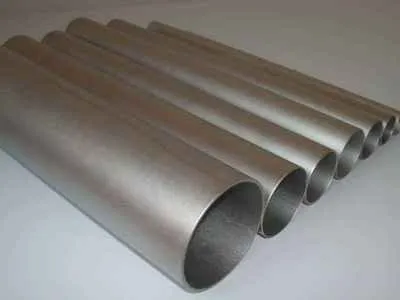
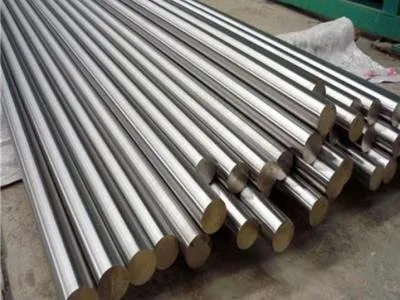
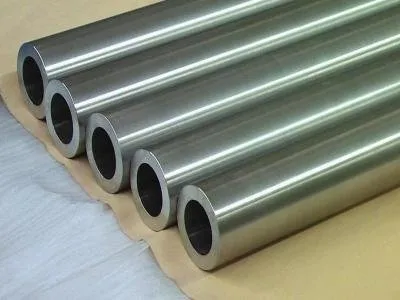
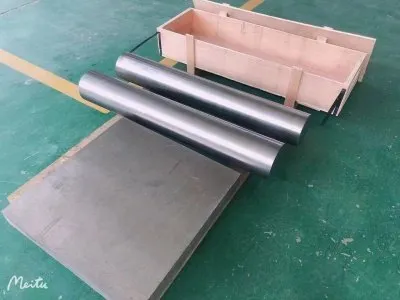
Foundries build parts; material suppliers provide the castable superalloy feedstock — ingot, electrode or billet — whose chemistry, cleanness and traceability gate downstream yield. Representative castable families supplied in bar, billet and electrode form include GH3030 (Ni-Cr solid-solution grade for furnace fixtures and heat-treatment hardware up to ~900 °C), GH3536 (the Hastelloy X family — combustor liner and duct castings with strong thermal-fatigue and oxidation performance), GH901 (iron-nickel precipitation-hardened grade for turbine disc and rotor hardware requiring high strength and moderate creep duty) and Inconel 601 (oxidation-resistant nickel-chromium grade for heat-treatment baskets and furnace rollers).
Common Casting Defects and Their Remedies
| Defect | Where It Forms | Why It Happens | Casting Countermeasure |
|---|---|---|---|
| Microshrinkage porosity | Thick sections, blade roots | Insufficient feeding during solidification | Riser design, controlled gradient, HIP closure |
| Hot tearing | Thin sections, fillet radii | Contraction strain at end of solidification | Alloy ductility window, mold preheat, shell compliance |
| Stray grains / freckles | DS/SX blades | Turbulence or gradient loss during withdrawal | Gradient control, withdrawal rate, baffle design |
| Oxide inclusions | Any section | Melt/atmosphere contamination | Vacuum integrity, filtration, cleaner remelt |
| Gamma-prime coarsening | Post-cast | Wrong aging time/temperature | Tight heat-treatment recipe per heat lot |
Heat Treatment and Post-Processing Rules
- Solution treatment dissolves coarse eutectic gamma-prime and homogenizes segregation; temperature sits just below the incipient melting point, so furnace tolerance is critical.
- Aging controls precipitate size: fine gamma-prime favors strength, coarser precipitates favor creep; multi-step aging balances both.
- HIP before heat treatment closes porosity without distorting thin walls; HIP after aging is not standard.
- Coatings — diffusion aluminides suit moderate oxidation duty; MCrAlY overlays handle hotter, corrosion-laden environments.
FAQ
Q: Why are nickel-based superalloys cast instead of forged for turbine blades? A: Blade geometry — thin twisted airfoils with internal cooling passages — cannot be forged or machined economically; investment casting produces near-net-shape with the required internal features.
Q: What is the difference between equiaxed, directional and single-crystal casting? A: Equiaxed castings have random grains (cheap, good fatigue); DS has columnar grains aligned to load (better creep); SX has no grain boundaries at all (best creep, hardest to cast).
Q: What does gamma-prime do in a cast superalloy? A: Ni₃(Al,Ti) precipitates coherently with the gamma matrix, blocking dislocation motion — the primary strengthening mechanism for creep resistance above 700 °C.
Q: Why is hot isostatic pressing used on cast superalloys? A: HIP applies high temperature and pressure to close internal microshrinkage porosity, improving fatigue life and part integrity.
Q: Can cast superalloy blades be welded for repair? A: Some grades allow qualified repair welding with preheat and post-weld heat treatment; gamma-prime-rich grades are crack-sensitive and often use brazing instead.
Q: What affects single-crystal casting yield? A: Gradient stability, withdrawal rate, stray-grain formation, mold quality and melt cleanliness — all combined, they make SX the lowest-yield, highest-cost casting route.
Ready to source castable superalloy feedstock? Contact Dura Alloy for GH3030, GH3536, GH901 and Inconel 601 in ingot, electrode, bar and billet with full chemistry certification — nicholas.zhu1212@gmail.com · WhatsApp 8618921275456 · Request a quote