Inconel 718 High-Temperature Alloy Forging: Optimizing Performance and Durability
Inconel 718 — and its Chinese equivalent GH4169 — is the workhorse of the forged superalloy world: turbine discs, shafts, fasteners, rings and casings that must hold strength at 650–700 °C while surviving thousands of cycles. What makes 718 special in the forge is that its properties are made in the process: the combination of forging temperature, deformation and subsequent heat treatment decides whether a disc delivers the specified grain size, tensile strength and fatigue life — or quietly fails a qualification test. The forging recipe is not a formality; it is the product.
This guide covers the real operating windows for forging Inconel 718 — temperature, deformation, dies, heat treatment and surface enhancement — and the mistakes that shorten the life of forged parts.
What Forging Does to Inconel 718
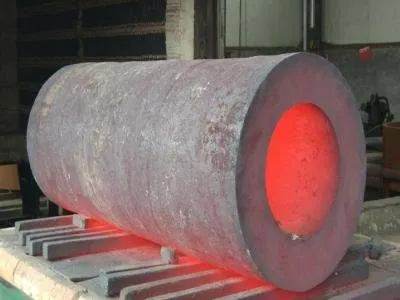
Hot forging is plastic deformation performed above the recrystallization temperature — that is what makes it “hot” working, as opposed to cold working below that temperature. For 718, the benefits come from dynamic recrystallization during deformation:
- Grain refinement — coarse as-cast structures break down into fine, uniform grains.
- Fiber flow — deformation aligns microstructure along load paths, improving fatigue resistance and toughness.
- Densification — forging closes internal porosity left by solidification.
The result is a component whose microstructure — not just chemistry — meets the specification. The entire practice of 718 forging exists to control that microstructure.
Forging Temperature: The Window That Matters
The working range for Inconel 718 is roughly 950–1,120 °C — not 1,200–1,250 °C. The alloy’s solidus sits around 1,260 °C, and working anywhere near 1,200 °C risks overheating: incipient melting at grain boundaries, massive grain growth and liquation cracking that destroy the part. The window breaks down into practical bands:
| Temperature Band | Practice |
|---|---|
| ~1,120 °C (start) | Initial breakdown of cast ingots and large reductions; stays below incipient melting |
| ~1,010–1,120 °C | Main hot working band — full recrystallization, safe deformation |
| ~930–1,010 °C | Finish-forging band for fine grain; below ~930 °C δ-phase and γ′ precipitation harden the alloy and cause cracking during deformation |
Modern practice — including δ-process / sub-solvus finishing — deliberately finishes deformation low in the window to drive fine grain for high-cycle-fatigue-critical parts. Every degree matters, which is why thermocouple-verified furnace and die temperatures are a quality requirement, not an option.
Dies, Deformation Rate and Press Practice
- Die material — hot-work tool steels, first among them H13 (4Cr5MoSiV1): they hold hardness at die-surface temperatures of several hundred degrees and resist thermal fatigue. Die design minimizes stress concentrations and guides metal flow for uniform section filling.
- Deformation rate — 718 is strain-rate sensitive. High ram speeds can cause adiabatic heating — a fast press stroke can push the local temperature above the safe band and overheat the structure — so moderate, controlled rates are preferred, especially near the end of forging when the alloy is most crack-sensitive.
- Interpass control — reheating between passes restores temperature, and cooling below the working window is avoided because the alloy hardens rapidly in the ~930 °C band.
The balance is not “faster is stronger” — it is “fast enough for productivity, slow enough to keep the temperature and strain inside the safe window.”
Heat Treatment: Solution and Aging
Forging sets the structure; heat treatment sets the strength. For Inconel 718 the standard route is:
- Solution treatment — approximately 955–1,010 °C, then air cool (rapid cooling for very heavy sections per specification). This dissolves the γ′ formed during forging and homogenizes the structure. A 1,180–1,210 °C “solution” would be catastrophic — near-solidus temperatures cause incipient melting and destroy the part — and the water/oil quench some sources describe is not the 718 norm.
- Aging — double aging, not tempering — 718 is a precipitation-hardened alloy and is aged, never “tempered” (a steel heat treatment). The classic cycle is about 718 °C / 8 h, furnace cool to 621 °C / 8 h, air cool, which grows a bimodal γ′ distribution balancing strength and ductility.
The mill test certificate should state the actual solution and aging schedule — that is the proof the heat treatment was done, and done right.
Surface Enhancement and Inspection
Post-forging steps tune the part for service:
- Shot peening — introduces compressive residual stress at the surface, sharply improving fatigue and stress-concentration resistance; standard on fatigue-critical forged hardware.
- Cold working — increases strength through work hardening. Note: cold working does not refine grain — deformation only distorts the structure; grain refinement comes from recrystallization during subsequent heat treatment. Cold-worked parts must be engineered as such, not assumed to be finer-grained.
Inspection completes the loop: ultrasonic testing of the forging for internal soundness, dimensional verification, and mechanical testing of representative samples against the required condition.
How 718 Fits the Forged Parts Ecosystem
Inconel 718 rarely forges alone — an engine or plant specifies a family of forged parts, each with its own best alloy:
- GH4145 (Inconel X-750 equivalent) — the classic forged fastener and spring alloy, precipitation-hardened, complementing 718 in bolting and instrumentation hardware.
- GH625 (Inconel 625 equivalent) — solid-solution-strengthened, easily forged and welded, used for rings, casings and hardware where fabricability matters more than peak strength.
- GH4738 (Waspaloy-type) — precipitation-hardened for hotter turbine parts than 718 can serve.
- GH2132 (A286-type) — the iron-based, cost-effective choice for moderate-temperature forged fasteners and turbine hardware.
Forging a 718 disc and a 4145 bolt from the same heat-lot discipline — controlled melting, forging windows and documented heat treatment — is what keeps a whole rotating assembly qualified.
FAQ
Q: What is the forging temperature for Inconel 718? A: Roughly 950–1,120 °C. Working above about 1,150 °C risks overheating and incipient melting near the 1,260 °C solidus; finishing low in the window (sub-solvus) promotes fine grain.
Q: Is hot forging done above or below the recrystallization temperature? A: Above — hot working is defined as deformation above the recrystallization temperature, which is what allows recrystallization and grain refinement. Working below it is cold working.
Q: What heat treatment does Inconel 718 need after forging? A: Solution treatment at about 955–1,010 °C with air cooling, followed by double aging around 718 °C / 8 h and 621 °C / 8 h. 718 is aged, not tempered.
Q: Why can’t Inconel 718 be forged at 1,200 °C? A: The alloy’s solidus is about 1,260 °C; working near 1,200 °C causes incipient melting at grain boundaries, liquation and severe grain growth — an overheated, cracked forging.
Q: Does cold working refine the grain of Inconel 718? A: No — cold working hardens by work hardening and distorts grains; grain refinement requires recrystallization, which happens only during subsequent heat treatment.
Q: How do I verify the quality of a forged Inconel 718 part? A: Require the forging temperature and heat-treatment record on the certificate, ultrasonic testing for internal soundness, and mechanical test data against the specified condition.
Source Forging-Grade Inconel 718 and Companion Alloys
Dura Alloy’s one-stop line — vacuum melting, vacuum electroslag, forging, heat treatment, rolling and machining — supplies forging-grade bar and billet in Inconel 718 / GH4169, GH4145, GH625, GH4738 and GH2132 with guaranteed composition, documented heat treatment and full heat traceability. Share your forging process and required condition for a confirmed quote.
📞 +86-18921275456 · WhatsApp 8618921275456 · Request a quote