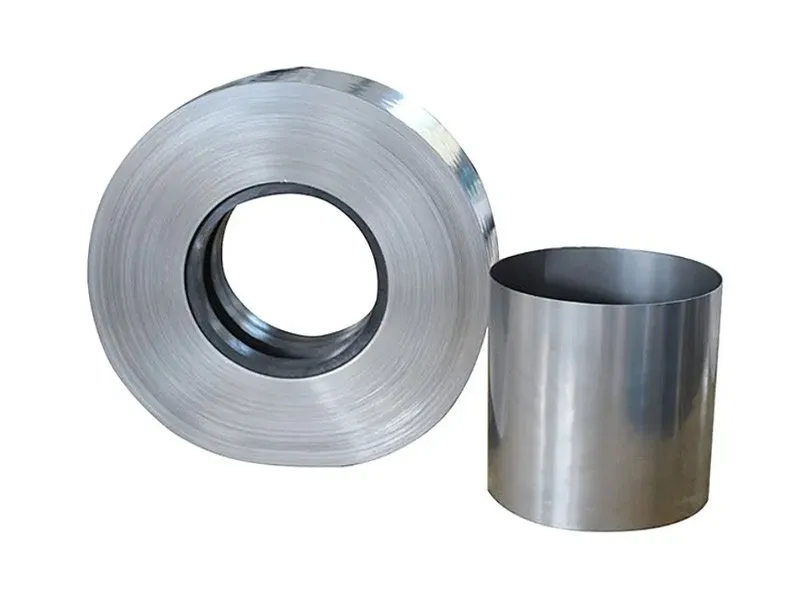
Analysis of the Thermal Expansion Coefficient in High Temperature Alloys
Thermal expansion is not a headline material property — until a bolted joint loosens in service, a casing seal opens at temperature, or a brazed assembly cracks after ten thermal cycles. In high-temperature alloy systems, the coefficient of thermal expansion (CTE) is the property that decides whether adjacent components grow together or tear each other apart. The numbers matter more than the rhetoric: most nickel superalloys expand at roughly 12–15 ×10⁻⁶/K, which is normal for their class — not “low expansion.” Genuinely low-expansion alloys are a small, specialized family. This guide sets the numbers straight, explains what drives them, and shows how they are measured, predicted and matched in practice.
The Numbers First: CTE Across Alloy Families
| Alloy Family | Typical CTE (×10⁻⁶/K) | Temperature Limit | Typical Role |
|---|---|---|---|
| Invar-type (4J36, Super-Invar 4J32) | ~1–2 | ~230 °C | Dimensional-stability instruments, precision tooling |
| Kovar-type (4J29) | ~5 | ~450 °C | Glass-to-metal and ceramic-to-metal seals |
| Controlled-expansion superalloys | ~7–11 | ~700 °C | Turbine casing and seal rings |
| Refractory metals (Mo, W) | ~4.5–5.5 | >1,000 °C (vacuum/inert) | High-temperature structural members |
| Nickel superalloys (718, 625, X) | ~12–15 | 650–1,100 °C | Turbine blades, discs, hot-section hardware |
| Ferritic steels (9–12% Cr) | ~11–13 | ~600 °C | Steam turbine rotors, casings |
Two conclusions jump out. First, the alloy classes doing the hottest work — nickel superalloys — have higher CTE than steels, not lower. Second, the term “low expansion” belongs only to the Invar and Kovar families (and controlled-expansion superalloys for moderate temperatures); calling 718 “low expansion” is simply wrong.
The Physics: What Actually Drives Expansion
Expansion reflects how interatomic spacing grows with temperature — governed by the anharmonicity of atomic bonding, not by “how ordered the crystal is.” The practical levers:
- Lattice type — close-packed face-centered cubic metals generally expand more than body-centered cubic metals; the nickel austenite matrix is why superalloys run at 12–15.
- Magnetic effects — the Invar anomaly — in iron-nickel alloys near the Invar composition, magnetostriction nearly cancels thermal expansion over a limited temperature band, producing CTE near 1–2 ×10⁻⁶/K. This is a special mechanism, not a general property of “ordered structures.”
- Composition — adding chromium, cobalt, molybdenum and tungsten shifts the matrix expansion modestly; refractory additions change stiffness and creep more than expansion.
- Microstructure — phases and precipitates contribute proportionally to their fraction; the matrix dominates.
The correct question is therefore not “does the alloy have low expansion?” but “does its expansion, over the service temperature band, match what the assembly can tolerate?”
Measuring CTE: Dilatometry Done Right
Dilatometry measures length change versus temperature in a controlled furnace:
- Specimen — a precisely dimensioned sample, machined with parallel ends.
- Heating — the sample is heated (and cooled) at a defined rate over the service temperature range.
- Measurement — an LVDT or optical system tracks length change continuously, typically against a reference standard.
- Output — the average CTE over temperature bands is calculated as ΔL/L per degree; data are reported per temperature interval, because CTE is not constant.
Accuracy depends on calibration, heating rate and atmosphere (oxidation on the sample adds noise); certified dilatometry data should name the temperature range and the heating rate used.
Predicting CTE: Models and Databases
Measurement is definitive but expensive per composition; prediction shortlists the candidates:
- CALPHAD databases — thermodynamic descriptions predict phase fractions with temperature, from which expansion is estimated by mixing rules.
- First-principles and molecular dynamics — DFT and MD simulate lattice dynamics and capture anharmonicity, giving expansion trends for candidate chemistries before melting a heat.
- Empirical databases — measured CTE of established grades remains the most reliable predictor for practical selection.
The mature practice combines all three: databases for established grades, CALPHAD for phase balance, atomistic models for new compositions.
Matching Expansion in Real Assemblies
Thermal stress comes from mismatch, not from expansion alone:
- Engine case versus blade — in gas turbines, casing alloys with lower expansion and blade superalloys with higher expansion are designed so tip-clearance control works across the operating range; controlled-expansion casing alloys exist precisely for this.
- Glass and metal seals — Kovar (about 5 ×10⁻⁶/K) matches borosilicate glass, which is why electronic and vacuum seals use it rather than a superalloy.
- Bolted joints and brazed assemblies — differential expansion between bolt, flange and gasket decides preload retention; matching CTE across the joint is part of the design.
- Instrumentation — precision dimensions across temperature demand the Invar family: 4J32 Super-Invar delivers near-zero expansion in its operating band.
Common Misconceptions About Expansion
“Low expansion means better stability — so the best high-temperature alloy has the lowest CTE.” Wrong. Nickel superalloys at 12–15 ×10⁻⁶/K handle thermal cycling routinely; their resistance comes from yield strength, toughness and controlled mismatch — not from low expansion. Low-CTE alloys exist for dimensional-stability roles (casings, seals, instruments), and their temperature range is limited (Invar to ~230 °C, Kovar to ~450 °C).
“More ordered crystal structure → lower expansion.” Wrong. Expansion is set by bonding anharmonicity and magnetic effects; the near-zero Invar behavior is a magnetic anomaly, not an ordering effect.
Both misunderstandings, published on engineering sites, cost real design errors — which is why certified CTE data should be part of every material spec.
FAQ
Q: What is the thermal expansion coefficient of Inconel 718? A: About 12–15 ×10⁻⁶/K — normal for a nickel superalloy, not “low expansion.”
Q: What alloys have genuinely low thermal expansion? A: Invar-type 4J36/4J32 (~1–2 ×10⁻⁶/K, to ~230 °C), Kovar 4J29 (~5, to ~450 °C), and controlled-expansion superalloys (~7–11, to ~700 °C).
Q: Why do nickel superalloys expand more than steel yet work fine at high temperature? A: Their thermal-fatigue resistance comes from yield strength, toughness and managed CTE mismatch — not from low expansion.
Q: How is the thermal expansion coefficient measured? A: By dilatometry — measuring specimen length change against temperature in a controlled furnace, with calibrated instrumentation and defined heating rate.
Q: What causes the Invar effect? A: Magnetostriction in iron-nickel alloys near the Invar composition nearly cancels thermal expansion over a limited temperature band — a magnetic anomaly, not an ordering effect.
Q: Why does CTE matching matter in assemblies? A: Because thermal stress comes from expansion mismatch: seals, bolted joints and brazed parts fail when adjacent materials grow at different rates across the temperature range.
Ready to source precision and high-temperature alloys? Contact Dura Alloy for 4J32 Super-Invar, 4J29 Kovar, 1J22 and 1J50 with certified property data and complete test certificates — 📞 +86-18921275456 · WhatsApp 8618921275456 · Request a quote