Titanium Alloy Load-Bearing Components for Spacecraft Applications
Titanium earns its place in spacecraft not because it melts especially high — it does not, titanium’s melting point is a moderate ~1,668 °C — but because it answers the one question space hardware always asks first: how much load can I carry per kilogram, and will it still be there at the end of the mission? Load-bearing titanium components are best understood by walking the mission profile: every phase imposes a different demand, and each phase is what drives grade selection, manufacturing route and qualification.
The Mission Profile — What Each Phase Demands
| Phase | Loads & Environment | What the Material Must Survive | Titanium’s Answer |
|---|---|---|---|
| Ground & integration | Handling, assembly, bolt preload | Fabricability, no latent damage | Machinable/forgeable; SPF for complex shapes |
| Launch | High vibration, acoustic loads, ~3–5 g static, shock | Fatigue crack initiation resistance, no embrittlement | High specific strength; fatigue-safe design |
| Orbit | Vacuum, thermal cycling (−150 to +150 °C typical), radiation, micro-meteoroid risk | Dimensional stability, no thermal-stress failure, low outgassing | Moderate CTE (~8.6–9.2×10⁻⁶/K); stable oxide |
| Cryogenic service | −253 °C propellant temperatures | Retained ductility, no brittle fracture | Ti-6Al-4V ELI keeps toughness at cryo temperatures |
| Hot duty | Engine peripherals to ~500–600 °C | Creep and oxidation resistance | Near-α grades to ~540 °C; TiAl to ~700–800 °C |
Each phase maps to a grade — the mission profile is the real selection spec.
Grade Selection by Duty
| Grade | Family | Best Duty | Typical Hardware |
|---|---|---|---|
| Ti-6Al-4V | α+β | General structure, fatigue-critical frames, fittings | Brackets, frames, fasteners, fittings |
| Ti-6Al-4V ELI | α+β (extra-low interstitial) | Cryogenic pressure vessels and tanks | Propellant tanks, liners |
| Ti-5Al-2.5Sn | Near-α | Creep duty to ~500 °C; historical cryo tanks | Engine-attached structure |
| Ti-6Al-2Sn-4Zr-2Mo | α+β / near-α | ~540 °C creep service | Compressor-ish hardware, hot structure |
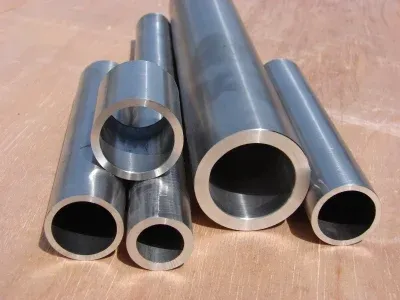
| CP Ti (TA1/TA2/TA3) | α | Corrosion and ductility service | Fittings, tubing, protection hardware |
| γ-TiAl | Intermetallic | 700–800 °C low-density duty | Advanced blade applications |
Why Titanium for Load-Bearing Structure
- Strength-to-weight — about 60% the density of steel with comparable-to-higher specific strength; a direct payload or fuel budget win.
- Cryogenic compatibility — ELI grades keep ductility at −253 °C, unlike many steels; pressure-vessel safety is a ductility question.
- Corrosion resistance — the self-healing oxide handles space-relevant media, and titanium’s low reactivity reduces galvanic pairing problems (isolation layers are still used at titanium–CFRP interfaces because of CTE and potential difference).
- Long-term stability — no environmental degradation over multi-year missions; predictable creep and fatigue behavior with qualified data.
- Fabricability — forging, superplastic forming, machining, welding and additive routes all available, so the lightest geometry can be made, not just hoped for.
Manufacturing and Qualification — Flight Parts Are Earned, Not Printed
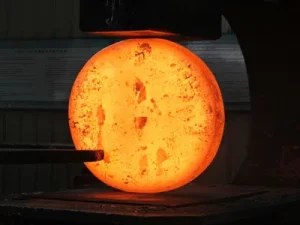
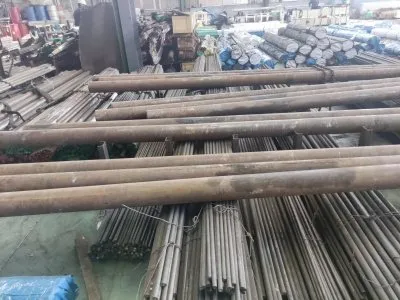
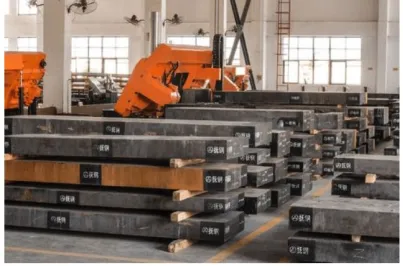
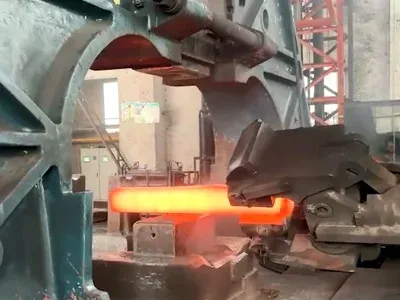
- Wrought routes: ingot → forge → machine; billet quality and ultrasonic inspection gate the hardware.
- Additive manufacturing: laser/electron-beam routes produce near-net complex parts — but a flight titanium AM part is qualified per part and per process (build parameters, porosity/NDT, fatigue allowables, material standard, and supplier certification), not adopted on a coupon.
- Every load-bearing part: chemistry per heat, mechanical data at the service temperature of the phase it serves, NDT to the flight standard, traceability to material and process.
FAQ
Q: Why is titanium used for load-bearing spacecraft components? A: For strength-to-weight: about 60% of steel’s density with comparable specific strength, plus corrosion resistance, cryogenic ductility and long-term stability.
Q: Which titanium grade is used for cryogenic tanks? A: Ti-6Al-4V ELI (extra-low interstitial) — retained ductility and toughness at −253 °C propellant temperatures.
Q: Is titanium’s melting point especially high? A: No — it is moderate (~1,668 °C); titanium’s space credentials are specific strength, corrosion resistance and cryogenic behavior, not absolute melting point.
Q: What duty does titanium handle in hot spacecraft hardware? A: Near-α grades serve to ~540 °C and γ-TiAl to ~700–800 °C; the hottest engine sections still use nickel superalloys.
Q: Is 3D-printed titanium flight-ready? A: Only per-part, per-process qualified: build parameters, porosity and NDT, fatigue allowables and material standard all certified — not assumed from a test coupon.
Q: Do titanium and carbon composites need isolation? A: Yes — CTE mismatch and potential difference mean titanium–CFRP joints use isolation layers to prevent interface damage over thermal cycling.
Need flight-grade titanium alloy supply for load-bearing hardware? Contact Dura Alloy at nicholas.zhu1212@gmail.com for Ti-6Al-4V, TC4, TA2 and TA18 — with mill certificates and heat traceability on request.