Grain Size Characteristics in High-Temperature Alloys
Grain size in a superalloy is a balance beam, not a target to minimize. Fine grains buy one set of properties; coarse grains buy another; the pivot between them is the service temperature. Therefore, “finer is better” and “coarser is better” are both half-truths — the engineering question is which side of the beam the duty sits on.
The Balance Beam
| Left Pan — What Fine Grain Buys | Right Pan — What Coarse Grain Buys |
|---|---|
| Yield strength (Hall–Petch) | Creep resistance — less boundary area for sliding and diffusion paths |
| Ductility and toughness at moderate temperature | Thermal stability of the structure at long service |
| Fatigue crack-initiation resistance | Higher-temperature capability of the same chemistry |
| LCF life for rotor duty | Lower oxidation/corrosion penetration along boundaries |
The pivot: above about 0.5 Tm, boundaries become weak paths. Below that temperature, fine grain is the gift; above it, coarse grain is the discipline.
The Property × Grain Preference Table
| Property | Prefers |
|---|---|
| Yield strength, RT/moderate | Fine (Hall–Petch) |
| Low-cycle fatigue | Fine |
| Creep at high temperature | Coarse — fine grain creeps faster |
| Fatigue crack propagation | Mixed — depends on path and microstructure |
| Oxidation / hot corrosion | Coarser, with fewer diffusion paths |
Therefore, the same alloy is processed differently for a blade duty than for a disc duty.
The Processing Levers
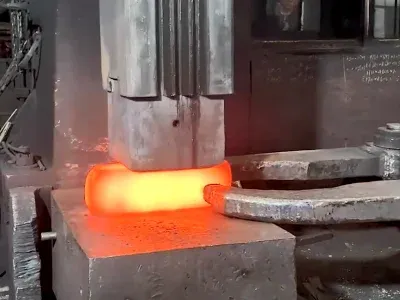
- Thermomechanical processing — hot working and recrystallization set the starting grain size.
- Heat treatment — temperature and time above the solution point control growth; dual aging preserves it.
- Pinning inhibitors — carbides, nitrides and precipitates at boundaries hold the structure against coarsening.
The Stability Section — Two Different Enemies
General coarsening is slow, uniform grain growth under sustained temperature — a gradual drift of properties. Abnormal grain growth is the selective, exaggerated growth of a few grains that swallows the matrix — sudden and severe. Both degrade performance, but they are different phenomena with different causes; inhibitors and controlled thermal history fight both.
The Measurement Standards
The industrial standard is optical metallography with ASTM E112 (grain size number G) — the number the spec sheet quotes. EBSD adds orientation and boundary-character detail, and XRD line broadening covers nano-scale structures. Measurement method matters as much as measurement itself.
The Extreme Case and the Engineering Embodiment
- DS/SX — directional solidification and single-crystal casting push grain control to its limit by removing grain boundaries where creep dominates (turbine blades).
- The dual-grain disc — the engineering compromise: a fine-grain rim for fatigue resistance and a coarse-grain core for creep, in one forging. This is the balance beam made into hardware.
FAQ
Q: What is the typical superalloy grain size? A: Wrought nickel-based grades commonly run 10–100 µm; cast versions coarser; DS/SX remove boundaries altogether.
Q: Does fine grain always improve strength? A: At moderate temperature yes (Hall–Petch); above ~0.5 Tm boundaries become weak paths and creep favors coarse grain.
Q: Why do creep parts want coarse grain? A: Less grain-boundary area means less boundary sliding and diffusion-assisted deformation.
Q: What is abnormal grain growth? A: Selective exaggerated growth of a few grains that swallows the matrix — distinct from slow, uniform coarsening, and both are fought by pinning inhibitors.
Q: How is grain size measured? A: Optical metallography per ASTM E112 (grain size number), plus EBSD for orientation and boundary character.
Q: What is a dual-grain disc? A: A forging with a fine-grain rim for fatigue and a coarse-grain core for creep — the fine-vs-coarse tradeoff built into one part.
Need grain-controlled superalloy and heat-treatable grades with certified microstructure? Contact Dura Alloy at nicholas.zhu1212@gmail.com for Nimonic 90, W18Cr4V, 310S and XM-27 — with mill certificates and heat traceability on request.