Automotive Turbocharger High-Temperature Alloy Turbine Wheel Performance and Material Analysis
The turbine wheel is the most thermally and mechanically loaded single part within an automotive turbocharger. It extracts energy from high-velocity, high-temperature exhaust gas and spins the compressor wheel to force compressed air into cylinders, lifting engine power density while helping meet modern fuel and emission regulations. Unlike stationary gas turbine blades, automotive turbine wheels face rapid thermal transients, frequent cold-hot cycling, extreme centrifugal load, and exhaust contaminants such as sulphur, ash and unburned carbon. Peak exhaust temperatures can surpass 1000°C for gasoline direct-injection performance engines, making cast nickel-base superalloys the dominant material solution for high-load applications.
Combined Loads Acting on Turbocharger Turbine Wheels
Three simultaneous load families define the material requirement envelope:
- Centrifugal stress: Rotational speeds often climb above 150,000 RPM. Blade roots and the hub bore experience steady high tensile stress; creep deformation will permanently distort the wheel if high-temperature strength is insufficient.
- Thermal cyclic stress: Vehicle start-up, hard acceleration and coast-down create steep temperature gradients between the hot blade tip and cooler hub. This cyclic strain drives thermal fatigue cracking, one of the top root causes of turbo wheel failure.
- Environmental attack: Exhaust gas oxidation, hot corrosion from fuel impurities, and erosion from particulate matter steadily degrade blade surface integrity and thin aerodynamic profiles.
Material selection cannot focus only on peak temperature; resistance to the coupling of creep, thermal fatigue and hot corrosion is mandatory.
Core Material Candidates and Microstructure Logic
Automotive cast superalloys rely primarily on gamma prime (γ’) Ni₃(Al,Ti,Nb) precipitates embedded within a gamma nickel matrix. Refractory alloying additions including molybdenum, tungsten, tantalum and niobium deliver solid-solution strengthening, while chromium forms a protective chromium oxide scale against oxidation.
- IN713C: The classic mass-market performance turbo wheel alloy. It has excellent castability, strong γ’ precipitation hardening, and balanced thermal fatigue resistance for gasoline turbo applications up to roughly 1000°C. Its aluminium and titanium content stabilises precipitates under rapid heat cycling, which is why it remains the industry default for aftermarket and OEM high-performance turbos.
- IN713LC: Low-carbon variant of IN713C. Reduced carbon minimises coarse carbide networks at grain boundaries, improving ductility and lowering sensitivity to hot tearing during investment casting. It is widely preferred for thin, complex blade geometries where casting cracks are a major yield risk.
- IN738LC: Higher chromium, tantalum and molybdenum content. It trades a small amount of castability for superior hot corrosion and sulphidation resistance, suited for diesel turbos and engines running high-sulphur or heavy ash fuels.
- IN100: High-strength premium cast superalloy for extreme racing and high-boost motorsport turbos. It carries a higher volume fraction of γ’ precipitates, delivering exceptional creep strength, though it is more difficult to cast and more sensitive to thermal shock than IN713 families.
Thermal conductivity, specific heat and density directly influence wheel performance. Lower thermal conductivity slows heat soak into the hub and shaft assembly; controlled density reduces centrifugal load at equal wheel diameter. Grain structure is another decisive variable: fine-grained investment cast wheels offer better thermal fatigue resistance, while coarser-grained variants deliver superior creep strength for steady-state continuous running.
Manufacturing Route for Turbo Superalloy Wheels
Nearly all automotive superalloy turbine wheels are made via vacuum investment casting:
- Wax pattern injection to replicate the complex aerodynamic blade geometry
- Ceramic shell dipping and stucco building
- Dewax and high-temperature shell sintering
- Vacuum induction melting and pouring of superalloy melt
- Controlled solidification to stabilise γ’ precipitate size and distribution
- Post-cast heat treatment: solution treatment followed by ageing to tune precipitate size and spacing
- Finish machining of the bore and backface, balancing, surface inspection and NDT screening
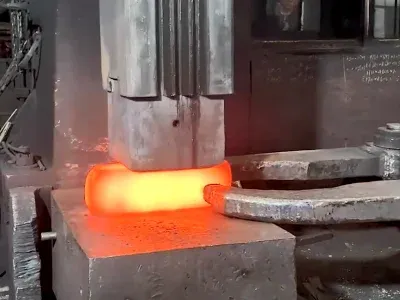
Forged superalloy wheels exist but are rare in standard automotive turbo products, because the twisted three-dimensional blade geometry is difficult and costly to forge. Additive manufacturing of turbine wheels is under active development, enabling internal cooling features that conventional casting cannot produce, though porosity and surface finish controls remain challenging for mass production.
Common Failure Modes for Superalloy Turbo Wheels
- Thermal fatigue crack initiation: Cracks start at blade trailing edges and sharp fillet radii after repeated heat cycles.
- Creep blade tip elongation: Gradual stretching of blade tips under sustained high speed and temperature, leading to casing rub and performance loss.
- Hot corrosion pitting: Sulphur and alkali salts break down the protective oxide scale, creating pits that act as fatigue crack initiation points.
- Casting defect propagation: Internal microshrinkage, inclusions and hot tears expand under cyclic load.
- Over-temperature precipitate degradation: Excessive exhaust temperature dissolves gamma prime, causing permanent strength loss.
Material Characterisation and Validation Testing
Material labs run a layered testing programme before grade adoption:
- High-temperature tensile and hardness testing to map yield strength across operating temperature bands
- Creep rupture testing at target temperature + stress combinations to quantify long-term dimensional stability
- Thermal cycling burner rig tests to reproduce road-cycle thermal fatigue
- Oxidation and hot corrosion exposure tests with synthetic exhaust atmospheres
- Rotating spin burst testing to validate overspeed safety margin
- FEA and CFD co-simulation to map temperature distribution, stress concentration and airflow before physical prototyping
Simulation drastically cuts development cycles, but physical bench and vehicle durability testing remains the final validation step for production turbo wheels.
Industry Development Trend
Future turbo material development follows two directions. First, optimised low-cost cast nickel superalloys with cleaner melt practices for mainstream passenger vehicle gasoline and diesel turbos. Second, lightweight high-temperature alternatives such as gamma titanium aluminide, which reduces rotational inertia and turbo lag, though it is limited to moderate exhaust temperature ranges. Advanced thermal barrier coatings are also applied on blade surfaces to push the allowable gas temperature higher while protecting the base superalloy substrate.
FAQ
Q: What alloy is most widely used for automotive performance turbo turbine wheels? A: IN713C is the dominant cast nickel-base superalloy for performance automotive turbocharger turbine wheels.
Q: What is the difference between IN713C and IN713LC? A: IN713LC uses low-carbon chemistry, which reduces brittle grain-boundary carbides and hot tearing risk during casting, ideal for thin-blade designs.
Q: Why is IN738LC selected for diesel turbo wheels? A: Higher chromium and refractory content gives IN738LC far better sulphidation and hot corrosion resistance against diesel exhaust ash and sulphur compounds.
Q: Are superalloy turbo wheels forged or cast? A: Almost all production automotive superalloy turbine wheels are vacuum investment cast, due to the complex twisted blade geometry.
Q: What is the main failure mode for turbo superalloy wheels in road vehicles? A: Thermal fatigue cracking from repeated heating and cooling cycles is the most frequent failure mechanism for road-going turbochargers.
Q: Can IN100 be used for regular street turbos? A: IN100 is a high-performance racing-grade alloy with excellent creep strength, but high cost and lower thermal shock tolerance make it unsuitable for standard street applications.
Ready to source vacuum-cast superalloy billet for turbocharger turbine wheel production? Contact Dura Alloy for IN713C, IN713LC, IN738LC and IN100. nicholas.zhu1212@gmail.com· WhatsApp: 8618921275456 · Request a quote