Corrosion-Resistant c Tubing: Essential Applications and Manufacturing Considerations
Corrosion-resistant high-temperature alloy tubing is the material that lets chemical plants, power stations, oil and gas platforms and aerospace systems run their hottest, most corrosive services — heat exchangers, reactors, boilers and process lines where ordinary steel tube fails within months. The combination of nickel, chromium and molybdenum chemistry gives these tubes simultaneous resistance to oxidation at elevated temperature and to aggressive chemical attack, which is why they are specified where both threats arrive together.
This guide covers what makes alloy tubing corrosion-resistant at high temperature, the applications that depend on it, the seamless tube forms and grades available, how the manufacturing and testing chain delivers the quality, and how to specify tubing correctly.
What Makes Tubing Corrosion-Resistant at High Temperature
The resistance comes from chemistry working as a team:
| Element | Contribution |
|---|---|
| Nickel | The austenitic base — phase stability at temperature, resistance to chloride and reducing-acid attack |
| Chromium | Builds the protective Cr₂O₃ scale that resists oxidation and sulfidation |
| Molybdenum | Solid-solution strengthening and pitting/crevice resistance in chloride service |
| Tungsten / cobalt | Additional high-temperature strength and creep resistance in advanced grades |
The service environments these tubes face — oxidation, sulfidation, hot corrosion by molten salts, reducing acids, and chloride pitting — each attack a different defense, so grade selection is an environment-matching exercise: a tube that thrives in a cracking-furnace radiant service will not automatically survive a wet chloride heat exchanger. This is why Hastelloy X, Inconel 601 and Inconel 617 coexist in the same plants — they protect against different threats.
Key Applications of Corrosion-Resistant Alloy Tubing
| Sector | Typical Service | Representative Grades |
|---|---|---|
| Chemical processing | Heat exchangers, reactors, distillation columns, cracking-furnace radiant tubes | Hastelloy X, Inconel 601, nickel alloy 200 |
| Power generation | Boilers, heat recovery steam generators, gas-turbine heat exchangers above 700 °C | Inconel 601, Inconel 617 |
| Oil and gas | Downhole tubulars, process heaters, sour-service heat exchangers | Corrosion-resistant nickel alloys, Inconel 625 family |
| Aerospace and defense | Engine and bleed-air ducting, heat exchangers | Inconel 625, Hastelloy X |
In chemical service, alloy tubes are the difference between a heat exchanger that lasts a decade and one that retires in a year: they hold their mechanical properties while the process chemicals attack, extending service life and cutting maintenance cost. In power generation, superheater and heat-recovery tubing must survive both combustion-gas corrosion and the high internal steam pressure — a combination that pushes temperature capability and weldability to their limits.
Product Forms and Grades
Corrosion-resistant alloy tubing is supplied as:
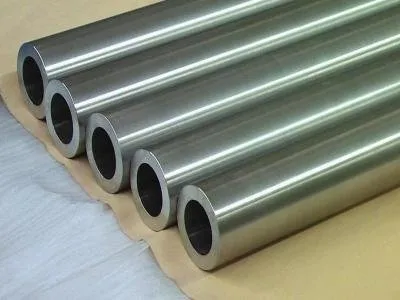
- Seamless pipe and tube — the dominant form, from small-diameter tubing for instrument lines and heat exchangers to process pipe — for example, Dura Alloy’s seamless nickel alloy pipe.
- Capillary tube — small-bore precision tubing for instrumentation and control lines.
- Pipe fittings and flanges — matching alloy systems for complete fabricated lines.
Delivery state matters as much as grade: most corrosion-resistant grades are supplied solution annealed (heat treated and quenched or rapidly cooled) to dissolve harmful phases and give optimum corrosion resistance, then pickled to restore a clean, scale-free surface. The buyer should specify standard, grade, dimensions and testing level together — not grade alone.
Manufacturing Process and Quality Control
The route from melt to installed tube is long, and each stage is controlled:
- Clean melting — vacuum induction melting (VIM) with ESR or VAR refining removes gases, sulfur and inclusions; inclusion control is corrosion and fatigue life.
- Hot working — extrusion or piercing at controlled temperature produces the seamless hollow; temperature windows prevent both cracking and uncontrolled grain growth.
- Cold working and drawing — reduces wall thickness and diameter to final dimensions, with intermediate anneals to restore ductility.
- Heat treatment — solution annealing sets the corrosion-resistant microstructure; parameters are recorded, not assumed.
- Testing and NDT — the routine battery includes chemical analysis, tensile and hardness testing, ultrasonic testing, eddy current inspection, hydrostatic testing and visual examination, plus PMI (positive material identification) on finished tubes.
- Documentation — mill test certificates with heat number, chemistry, heat-treatment record and test results complete the product.
Every one of these steps is why “corrosion-resistant” on a certificate means something: the grade is only the starting point, and the manufacturing chain is what delivers the promised performance.
How to Specify Corrosion-Resistant Alloy Tubing
A complete enquiry should state:
- Grade and standard — e.g., Inconel 601, 617 or Hastelloy X to ASTM B167, B423 or an equivalent GB/T product standard.
- Dimensions — outside diameter, wall thickness or schedule, length.
- Delivery state — solution annealed and pickled, with surface finish requirement.
- Testing level — required NDT (UT/eddy current), hydrostatic test, PMI.
- Volume and lead time — to align production planning.
- Certification — full mill test certificates and heat traceability.
A well-specified enquiry gets a precise quote and a tube that meets the standard the first time — ambiguity in any of these fields invites re-work at the receiving end.
FAQ
Q: What alloys are used for corrosion-resistant high-temperature tubing? A: Nickel-based grades such as Inconel 601, Inconel 617, Inconel 625 and Hastelloy X, with seamless tube forms per ASTM B167/B423 and equivalent standards.
Q: What is the difference between corrosion resistance and oxidation resistance? A: Oxidation resistance is the ability of the surface oxide scale to resist high-temperature air attack; corrosion resistance covers chemical attack — acids, chlorides, sulfides — often at lower temperatures. Alloy tubing for hot corrosive service must have both.
Q: Why are these tubes supplied solution annealed? A: Solution annealing dissolves harmful phases and restores optimum corrosion resistance and ductility; rapid cooling after the anneal locks in the desired structure.
Q: How is seamless alloy tubing manufactured? A: By hot extrusion or piercing of a solid billet, followed by cold drawing, intermediate annealing and final solution treatment — no weld seam, hence no weld-zone weakness.
Q: What testing does alloy tubing undergo? A: Chemical analysis, tensile and hardness tests, ultrasonic and eddy-current inspection, hydrostatic testing, visual examination and PMI, all recorded on the mill test certificate.
Q: How do I choose between Inconel 601, 617 and Hastelloy X? A: Match the environment: 601 for oxidation and heat-exchanger service, 617 for higher-temperature creep and oxidation, Hastelloy X for hot corrosive gas paths. State your service conditions and the supplier will confirm the fit.
Source Seamless Corrosion-Resistant Alloy Tubing
Dura Alloy’s one-stop line — vacuum melting, vacuum electroslag, forging, heat treatment, rolling and machining — supplies seamless nickel alloy pipe and tubing, Inconel 601 sheet and components, Inconel 617 and Hastelloy X with guaranteed composition, non-destructive testing and full heat traceability. Share your grade, dimensions, standard and delivery state for a confirmed quote.
nicholas.zhu1212@gmail.com· WhatsApp 8618921275456 · Request a quote