Heat Treatment Duration for High-Temperature Alloys: Process Times and Considerations
Heat treatment is where a high-temperature alloy’s chemistry becomes its performance. A nickel superalloy leaves the melting shop as a structure of as-cast or wrought grains; heat treatment then decides whether that structure delivers the intended strength, creep resistance and ductility — or something far less. The treatment duration is not a fixed number: it is set by the alloy’s composition, the section thickness, the process type, and the properties the application requires. Get the time wrong, and no amount of premium chemistry saves the part.
This guide covers the four core heat treatment processes for high-temperature alloys, their typical temperatures and durations, the cooling that completes them, and how buyers verify that a delivered product was correctly heat treated.
The Four Core Heat Treatment Processes
| Process | Purpose | Typical Temperature | Typical Hold Time | Typical Cooling |
|---|---|---|---|---|
| Solution treatment | Dissolve precipitates, homogenize, set grain structure | 980–1,200 °C | 1–4 h (scaled by thickness) | Air cool or faster for optimum properties |
| Aging treatment | Precipitate γ′ and carbides for strength | 700–900 °C | 2–24 h, sometimes staged | Air cool; staged furnace cool for multi-step aging |
| Stress relief | Reduce residual stress from welding, machining, cold work | 600–850 °C | 1–3 h | Controlled slow cool |
| Annealing | Soften, restore ductility, improve machinability | 900–1,100 °C (full) / 650–850 °C (process) | 2–6 h (full) / 1–2 h (process) | Very slow (full) / controlled (process) |
Each process answers a different metallurgical question — and in practice the heat-treatment cycle of a premium part is a sequence: solution treatment, then aging, sometimes with stress relief in between.
Solution Treatment: Dissolving and Homogenizing
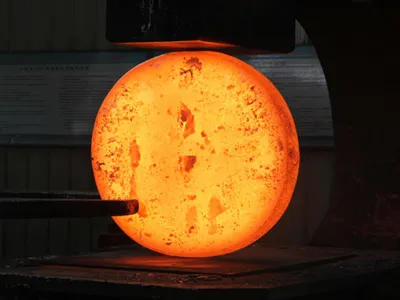
Solution treatment holds the alloy above the γ′ solvus to dissolve the precipitates formed during processing and homogenize the composition. The key variables:
- Temperature vs the solvus — solution treatment must be above the γ′ solvus to dissolve strengthening phases, but below incipient melting. The window is narrow and alloy-specific: Inconel 718 / GH4169 is typically solution treated around 955–1,010 °C, while a solid-solution-strengthened grade like Hastelloy X is annealed around 1,175 °C.
- Hold time scales with thickness — the soak must be long enough for the thickest section to reach temperature uniformly, roughly one hour per inch of section for many grades, then additional time for homogenization.
- Cooling after solution — for optimum properties, most superalloys are air-cooled or faster after solution treatment; slow furnace cooling can re-precipitate phases coarsely and waste the solution treatment.
Aging Treatment: Building the Strengthening Precipitates
Aging — precipitation treatment — is done below the solvus to re-precipitate fine γ′ (Ni₃(Al,Ti)) particles that block dislocation motion. Time is the dial here, and the response is a curve, not a monotonic climb:
- Under-aging — precipitates too small and sparse; strength below potential.
- Peak aging — the precipitate size and fraction giving maximum strength; the usual production target.
- Over-aging — particles coarsen; strength falls while ductility and creep stability may improve.
So “longer aging increases strength” is only true up to the peak — beyond it, longer aging reduces strength. Many aerospace grades use staged aging to balance the property set. Two common examples:
- Inconel 718 / GH4169 double aging — about 718 °C / 8 h, furnace cool, then about 621 °C / 8 h, air cool, giving the high-strength condition used in discs and fasteners.
- Waspaloy — solution treatment near 1,080 °C followed by aging around 843 °C / 4 h plus 760 °C / 16 h, a long multi-step cycle for high-temperature strength.
Aging times of 2–24 hours are normal; the exact schedule is specified by the grade, the product form and the required property class — and should be stated on the mill test certificate.
Stress Relief and Annealing
- Stress relief — used after welding, machining or cold forming to lower residual stress without changing the primary structure. Temperatures of 600–850 °C for 1–3 hours are typical; complex geometries need longer soaks and controlled cooling to avoid re-introducing stress.
- Full annealing — softens the alloy, restores ductility and improves machinability: 900–1,100 °C with a very slow cool.
- Process annealing — a milder 650–850 °C cycle used between working steps for controlled recovery rather than full recrystallization.
Note that some solid-solution-strengthened grades (e.g., Hastelloy X) use their high-temperature anneal as both solution treatment and softening step — the same heat serves two purposes.
Heating and Cooling Rates: Time Beyond the Hold
Total process time is heating + hold + cooling, and the rates matter as much as the durations:
- Heating — superalloys are heated slowly, especially thick sections, to limit thermal gradients and avoid cracking; rapid or uneven heating risks distortion and surface damage.
- Cooling — the exit route sets the final structure: air cooling for solution-treated grades, staged furnace cooling for multi-step aging, very slow cooling for full annealing. Quenching is used only where the specification requires it — many superalloys are air-cooled or furnace-cooled by design.
What Determines the Right Duration
Four inputs fix the correct heat-treatment time:
- Alloy composition — diffusion rates of the alloying elements set the kinetics of dissolution and precipitation; a molybdenum-rich grade homogenizes differently from a niobium-strengthened one.
- Section geometry — hold time is scaled so the thickest region reaches and holds the target temperature; thin strip can soak in minutes, thick forgings need hours.
- Desired property balance — creep resistance, fatigue strength, ductility and oxidation resistance pull in different directions; the schedule is tuned to the application’s dominant requirement.
- Delivery state — the buyer’s specification (solution annealed + pickled, aged condition, stress relieved) fixes which cycles the mill must run and document.
Verifying Heat Treatment Quality
Heat treatment is invisible after the fact, which is why documentation and verification are the whole game:
- Furnace records — time-at-temperature charts showing the actual cycle, with calibrated thermocouples and soak confirmation.
- Mill test certificates — heat number, heat-treatment schedule, and the mechanical test results that prove the intended condition was achieved.
- Metallurgical verification — grain size, γ′ condition and hardness checks confirm the microstructure matches the specified state.
- Mechanical testing — tensile, hardness and, where required, impact or creep-rupture data validate the treatment.
Buyers should specify the delivery state explicitly and require the heat-treatment record on the certificate — a plate labeled “solution annealed” is only as good as the chart behind it.
FAQ
Q: What is solution treatment for Inconel 718 / GH4169? A: Heating to roughly 955–1,010 °C to dissolve γ′ and homogenize, followed by rapid cooling — the preconditioning step before double aging.
Q: Why is Inconel 718 double-aged? A: Two-step aging (about 718 °C then 621 °C) grows a bimodal γ′ distribution that balances high strength with acceptable ductility — a single aging step cannot hit the same property balance.
Q: Does longer aging always increase strength? A: No. Strength rises to a peak-aged condition, then falls with over-aging as precipitates coarsen. The correct time is the one that hits the specified condition, not the longest possible.
Q: What is the difference between solution treatment and annealing? A: Solution treatment dissolves precipitates above the solvus for a defined structure; annealing softens and restores ductility, often at lower temperatures with slow cooling. For some solid-solution grades the two coincide.
Q: How long does a typical superalloy heat-treatment cycle take? A: From a few hours for solution-treated thin sections to 24+ hours for multi-step aging of thick forgings — heating and cooling add several more hours beyond the holds.
Q: How do I verify that material was correctly heat treated? A: Require the furnace time-at-temperature record, the heat-treatment schedule on the mill test certificate, and metallurgical plus mechanical test data confirming the specified condition.
Source Heat-Treated High-Temperature Alloys with Full Records
Dura Alloy’s one-stop line — vacuum melting, vacuum electroslag, forging, heat treatment, rolling and machining — delivers high-temperature alloys and Inconel in the specified delivery state — solution annealed, aged or stress relieved — with documented cycles and full test certificates. Share your grade, form and required condition for a confirmed quote.
nicholas.zhu1212@gmail.com · WhatsApp 8618921275456 · Request a quote