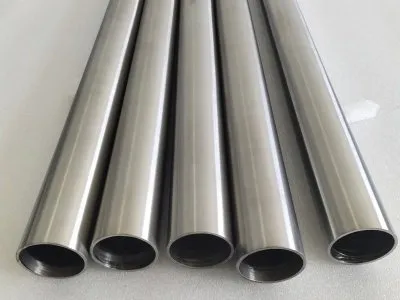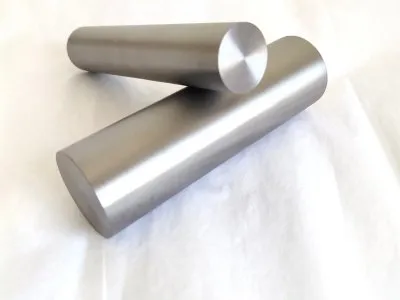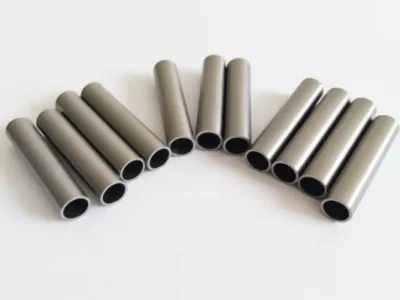
High-performance alloy material for industrial engineering and critical application conditions.
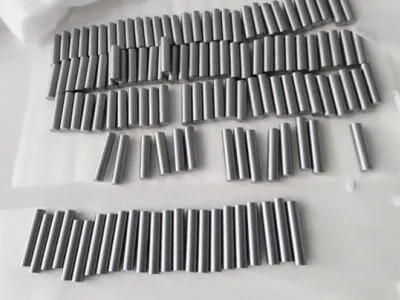
1. Introduction to niobium rods
2. Application fields of niobium rods
Used to produce niobium wire. Used to produce niobium processing parts. Internal structural parts of high-temperature furnace. Accessories in corrosion-resistant chemical equipment.
3. Chemical composition of niobium rods
| Chemical Constituents (%) | ||||||||||||
| Brand number | Main elements | Impurity content (≤) | ||||||||||
| Nb | Fe | Si | Ni | W | Mo | Ti | Ta | O | C | H | N | |
| Nb1 | Bal | 0.004 | 0.004 | 0.002 | 0.005 | 0.005 | 0.002 | 0.05 | 0.012 | 0.0035 | 0.0012 | 0.003 |
| Nb2 | Bal | 0.01 | 0.01 | 0.005 | 0.02 | 0.01 | 0.004 | 0.07 | 0.015 | 0.0050 | 0.0015 | 0.008 |
4. Mechanical properties of niobium rods
| Brand number | Minimum tensile strength (MPa) | Minimum yield strength (MPa) (0.2% residual deformation) |
Minimum elongation (%) (25.4mm metering) |
| R04200,R04210 Nb1,Nb2 |
125 | 85 | 25 |
5. Niobium rod tolerance (mm)
| diameter | Diameter tolerance | Length tolerance |
| 3~4.5 | ±0.05 | ±2 |
| 4.5~6.5 | ±0.05 | ±2 |
| 6.5~10.0 | ±0.10 | ±2 |
| 10.0~16.0 | ±0.15 | ±2 |
| 16.0~18.0 | ±0.15 | ±2 |
| 18.0~25.0 | ±0.30 | ±2 |
| 25.0~40.0 | ±0.50 | ±2 |
| 40.0~50.0 | ±0.60 | ±2 |
| 50.0~65.0 | ±0.70 | ±2 |
| 65.0~95.0 | ±1.00 | ±2 |