Optimized Investment Casting for High-Temperature Alloy Turbine Guide Vanes
Turbine guide vanes sit directly in the combustor exit flow, where gas temperature can exceed 1,500 °C — far above any metal’s limit. They survive because the vane metal temperature stays near 950–1,100 °C via internal cooling and coatings, and because the alloy and the casting route deliver the required strength at that temperature. Investment casting (lost-wax casting) is the only practical way to produce vanes with internal cooling passages, thin airfoils and integral shrouds. Optimization here is not one step — it is a ten-stage ledger, where each stage’s critical control prevents a specific defect.
The Ten-Stage Casting Ledger
| # | Stage | Critical Control | Defect It Prevents |
|---|---|---|---|
| 1 | Pattern making | Industrial pattern wax — engineered filler-loaded blends of hydrocarbon, resin and microcrystalline waxes, not simple beeswax/paraffin — injected under pressure with controlled cooling | Pattern distortion, sinks, flash |
| 2 | Pattern assembly (gating) | Sprue, runner and ingate sizing; cluster design balancing fill and feeding | Misruns, shrinkage at junctions |
| 3 | Shell building | Multiple slurry coats: zirconia/silica facecoat for inertness, silica-alumina backup coats; binder is colloidal silica (silica sol), not phenolic resin — resin-based systems serve cores/lost cores only | Shell-metal reaction, cracked shells |
| 4 | Dewax | Autoclave dewaxing (rapid steam) or flash-fire dewaxing so the wax escapes before shell stress peaks | Shell cracking, wax residue carbon |
| 5 | Firing / sintering | Controlled ramp to firing temperature; sinter and cure the shell, burn out residual wax | Shell weakness, gas evolution during pour |
| 6 | Mold preheat | Shell preheated to casting temperature so thin airfoil sections fill completely | Cold shuts, misruns |
| 7 | Vacuum pouring | Superalloy melted in vacuum induction furnace and poured under vacuum/inert control | Oxide inclusions, gas porosity |
| 8 | Solidification control | Cooling rate, gradient and (for DS) withdrawal rate set grain structure: equiaxed for toughness, DS/columnar for creep | Shrinkage, stray grains, freckles |
| 9 | Knockout, cut-off, finishing | Shell removal, runner cut-off, blasting, core removal (for cored passages) | Residual shell, blocked cooling holes |
| 10 | HIP, heat treatment, NDT | HIP closes microshrinkage; solution + aging sets gamma-prime; X-ray/CT, penetrant and dimensional checks gate the part | Porosity-induced fatigue, wrong strength condition |
The Parameter Envelope That Makes or Breaks a Vane
| Parameter | What It Controls | Optimization Direction |
|---|---|---|
| Melt / pouring temperature | Mold filling vs oxidation/contamination | High enough for complete thin-section fill; low enough to limit melt oxidation |
| Mold preheat temperature | Fill, thermal shock, surface reaction | Matched to alloy and section thickness |
| Cooling / solidification rate | Grain size, porosity, segregation | Slow-and-controlled for castings; gradient-controlled for DS/SX |
| Shell permeability & strength | Back-pressure defects, cracking | Balanced by coat count, stucco and firing schedule |
| Post-cast heat treatment | Gamma-prime size and distribution | Grade-specific solution + aging windows |
Material Discipline Around the Vane
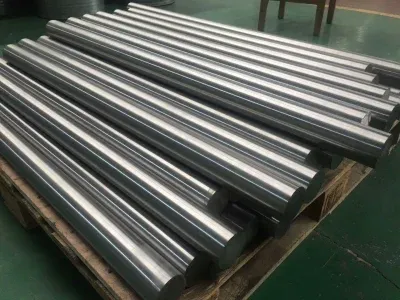
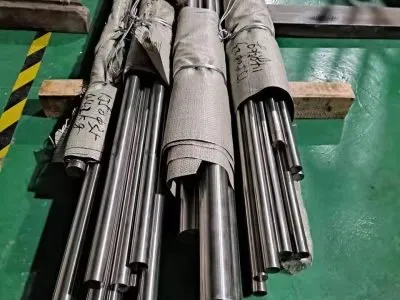
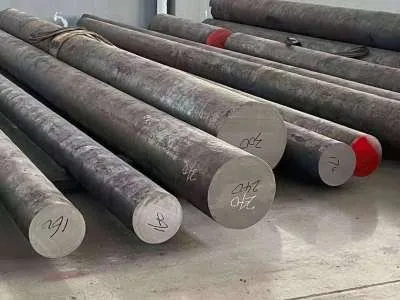
The vane alloy is cast superalloy — but the foundry’s supporting hardware and feedstock carry the same discipline. Ni-Cr and Fe-Ni-Cr superalloy feedstock such as Inconel 600 and GH825 must arrive with tight chemistry and low tramp elements, because inclusions and segregation inherited from feedstock reappear as casting defects. Heat-treatment fixtures see years of furnace service — 309S stainless is a standard answer for annealing baskets and racks. And where the hot end demands refractory margin, tantalum tube represents the class of high-melting materials used in the most extreme hardware and as master-alloy additions.
FAQ
Q: What is investment casting for turbine guide vanes? A: A lost-wax precision casting process: a wax pattern with internal core geometry is coated with ceramic shell, dewaxed, fired and poured with superalloy melt to produce a near-net-shape vane.
Q: Why are guide vanes investment cast rather than forged? A: Vane geometry — thin airfoils, internal cooling passages and integral shrouds — cannot be forged; investment casting produces the shape with internal features in one piece.
Q: What binder is used in ceramic shell building? A: Colloidal silica (silica sol) is the standard shell binder; phenolic resin systems serve cores and lost cores, not the main shell coats.
Q: What temperature can turbine guide vanes withstand? A: Gas temperature can exceed 1,500 °C, but the vane metal operates near 950–1,100 °C through internal cooling, coatings and alloy selection.
Q: What defects does optimized investment casting prevent? A: Misruns, cold shuts, shrinkage porosity, shell-metal reaction, stray grains, inclusions and blocked cooling passages — each controlled at a specific stage.
Q: Why is HIP applied to cast vanes? A: Hot isostatic pressing closes internal microshrinkage porosity that would otherwise shorten fatigue life under cyclic gas loads.
Ready to source superalloy feedstock and foundry hardware? Contact Dura Alloy for Inconel 600, GH825, 309S Stainless and Tantalum Tube with full certification and heat traceability — nicholas.zhu1212@gmail.com· WhatsApp 8618921275456 · Request a quote