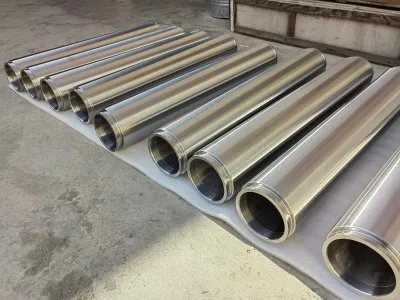
Production of Nickel-Based Superalloys
Making a nickel-based superalloy is a five-stage production line — and the first strategic decision is not in the furnace but on paper: which route the part takes (cast, wrought or powder). The route decides the microstructure, and the microstructure decides the duty. This guide runs the line, splits the routes, and corrects two common misunderstandings.
The Five-Stage Production Line
| Stage | Core Discipline |
|---|---|
| 1. Raw materials | High-purity nickel + precisely weighed alloying elements (Cr, Co, Ta, Nb, Ti, Al, Re); impurities minimized — they set the final properties |
| 2. Vacuum melting | VIM (vacuum induction melting) → VAR or ESR; vacuum blocks oxygen/nitrogen pick-up; remelt cycles homogenize and strip inclusions; temperature control limits evaporation of high-vapor-pressure elements (e.g., manganese) |
| 3. Casting | Investment casting for near-net complex shapes; directional solidification and single-crystal casting eliminate grain boundaries in the loading direction — the creep enabler |
| 4. Hot working | Homogenization (~1100–1250°C) removes segregation; forging, rolling or extrusion breaks the cast structure and refines grain — temperature, strain rate and reduction all specified |
| 5. Heat treatment + final | Solution treatment dissolves unwanted phases; aging precipitates strengthening γ′; machining, surface treatment and NDT close the loop |
The Three-Route Split
| Route | Product | Logic |
|---|---|---|
| Cast | Turbine blades — DS / single crystal | Grain boundaries are the weak path; eliminate them for creep |
| Wrought (cast + forge) | Discs, rotors, structural hardware | Hot working refines grain and controls precipitates |
| Powder metallurgy | Near-net discs, high-γ′ grades | Fine uniform structure, segregation-free — then forged and heat treated |
The γ′ Chemistry Box
- Al + Ti set the γ′ volume fraction — more strengthening phase, higher temperature capability.
- Re (and Ru) lift creep resistance in the most advanced single-crystal grades.
- Solution treatment sits relative to the γ′ solvus; the aging sequence (single or two-step) sets precipitate size, distribution and volume fraction.
- The precise claim: γ′ precipitates during cooling and aging after solution treatment — not during casting solidification.
The Correction Box
| Claim in Circulation | The Accurate Statement |
|---|---|
| “Vacuum induction furnaces (VIF)” | The correct term is VIM — vacuum induction melting; the clean-melt standard is VIM → VAR (or ESR) |
| “Cooling rate during solidification controls γ′” | Refined: solidification controls segregation and dendrite spacing; γ′ forms during cooling from solution treatment and aging |
| “Homogenization only” | Segregation is real — and so are freckle defects in large VAR ingots, controlled by melt practice |
FAQ
Q: How are nickel-based superalloys melted? A: By VIM (vacuum induction melting) followed by VAR or ESR — vacuum blocks gas pick-up and the remelt refines the ingot.
Q: What does directional solidification do? A: Aligns or eliminates grain boundaries in the loading direction — the creep enabler for turbine blades.
Q: When is a superalloy cast, wrought or powder? A: Blades cast (DS/SX), discs wrought or powder — each route optimizes a different microstructure for its duty.
Q: What drives γ′ strengthening? A: Aluminum and titanium set the γ′ volume fraction; rhenium lifts creep resistance in advanced single-crystal grades.
Q: When does γ′ actually form? A: During cooling and aging after solution treatment — not during casting solidification.
Q: What is homogenization for? A: ~1100–1250°C treatment removes chemical segregation from casting before hot working refines the grain.
Need nickel-based superalloy supply with certified melt history for casting, forging or PM programs? Contact Dura Alloy at nicholas.zhu1212@gmail.com for Nimonic 90, GH3044, GH3128 and Inconel 600 — with mill certificates and heat traceability on request.