Titanium Alloy Forging Process and Applications
The single most useful fact in titanium forging is the beta transus (Tβ) — the line that decides which microstructure you produce. Forge below it and you get one structure; forge above it and you get another; the two deliver different property sets. Therefore, titanium forging is best read as a temperature-window decision map. This guide draws the map, walks the stages, and maps the applications.
The Temperature-Window Decision Map
| Window | Practice | Microstructure | Property Signature |
|---|---|---|---|
| Below Tβ (α+β forging) | Forge in the α+β field (typical ~800–1000°C by grade) | Bimodal / equiaxed α + β | Strength, ductility, LCF — the airframe and disc choice |
| Above Tβ (β forging) | Forge above the transus, controlled cool | Lamellar / coarse prior-β | Fracture toughness and creep — the high-temp-toughness choice |
| Overheating | Too long above Tβ | Coarse prior-β grain | Lost ductility and fatigue — the defect to avoid |
The master rule: temperature above or below Tβ is a design decision, not an accident — choose the window for the property you need, and control the time in it.
The Process Stages
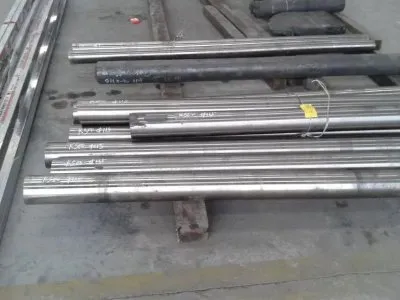
- Billet preparation — melting, casting and homogenization remove segregation and defects.
- Preheating — controlled heating protects against warping and cracking; air heating forms scale and a brittle α-case, so heating practice and post-forge removal are specified.
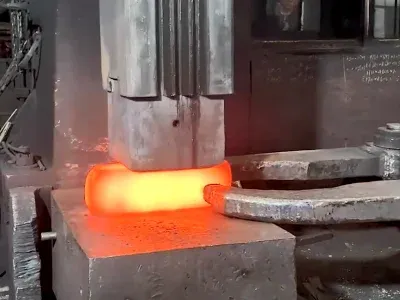
- Forging — open-die for flexibility and simpler shapes; closed-die for tight tolerances and controlled grain flow; hydraulic presses deliver the compressive force.
- Post-forge heat treatment — annealing or aging tunes the final property balance.
- Inspection — visual, ultrasonic/X-ray NDT and mechanical testing against the specification.
The Challenge Box
- Low thermal conductivity — heat stays where it is; soak times and die temperatures must be managed.
- Work hardening — flow stress rises as the part deforms; force and die design must anticipate it.
- Strain-rate sensitivity — titanium’s flow behavior changes with speed; isothermal forging manages it for complex shapes.
- Alpha-case — oxygen-enriched surface from air heating is hard and brittle; removed or avoided by controlled atmosphere.
The Application Map
| Sector | Titanium Forgings | Why |
|---|---|---|
| Aerospace | Airframe fittings, engine components, landing gear | Strength-to-weight, thermal-stress resistance |
| Automotive | Exhaust, connecting rods, suspension hardware | Lightweight, high performance |
| Marine | Propeller systems, hydraulic hardware, offshore equipment | Corrosion resistance in seawater |
| Medical | Surgical instruments, forged implant stems | Biocompatibility, durability |
FAQ
Q: What decides the forging temperature for titanium? A: The beta transus (Tβ) — forging below it gives bimodal strength/LCF structures; above it gives lamellar creep/toughness structures.
Q: Why is Tβ called the master parameter? A: Above or below Tβ changes the microstructure, which changes the property set — the window is a design decision.
Q: Open-die or closed-die? A: Open-die for flexibility and simpler shapes; closed-die for tight tolerances, controlled grain flow and better properties.
Q: Why is titanium forging difficult? A: Low thermal conductivity, work hardening and strain-rate sensitivity demand precise temperature and force control.
Q: What is alpha-case in forging? A: The hard brittle oxygen-enriched surface layer from air heating — removed by machining or avoided with controlled atmosphere.
Q: Where are titanium forgings used? A: Aerospace (airframe, engines, landing gear), automotive, marine and medical hardware.
Need titanium and forging-grade supply with certified mill history? Contact Dura Alloy at nicholas.zhu1212@gmail.com for TA2, Zirconium Rod, SKD61 and 35CrMnSiA — with mill certificates and heat traceability on request.