How to Enhance Coarse Grain Size in High-Temperature Alloys
Coarse grains are wanted for one dominant reason: creep resistance. In sustained high-temperature service, grain boundaries slide, cavities nucleate along them, and creep rate rises as boundary area increases. Fewer, larger grains mean less boundary area — and that is exactly why creep-critical superalloy hardware (turbine discs, rotor forgings, high-temperature fasteners) is routinely specified with coarse grain size, while fine grain is favored for low-temperature strength and fatigue initiation resistance. Getting coarse grains is a deliberate metallurgical program, and it is astonishingly easy to get wrong — several common explanations of “how to coarsen grain” describe mechanisms that actually do the opposite.
Misconception 1: “Fine grains have less grain-boundary area”
What’s actually true: fine grains have more grain-boundary area per volume, not less. Grain refinement increases boundary area; grain coarsening reduces it. The opening premise “fine grain reduces boundary area” is exactly inverted — and so is the common claim that fine grains automatically beat coarse grains in hot service. For creep-dominated duty, coarse (or directional/single-crystal) structures win; for fatigue initiation and low-temperature strength, fine structures win. The choice is duty-driven, not universally “finer is better.”
Misconception 2: “Stabilize grain boundaries so they don’t coarsen”
What’s actually true: stabilizing (pinning) grain boundaries is precisely how you prevent grain growth. If your goal is coarse grains, the boundary must be free to migrate — which means removing pinning obstacles, not stabilizing them. The phrase “elements such as nickel and chromium stabilize grain boundaries, preventing coarsening” mixes up matrix elements (Ni, Cr) with pinning particles (carbides, borides, intermetallics). Ni and Cr do not pin boundaries. What pins boundaries are fine precipitates and segregants — carbides from carbon, borides from boron — and to grow coarse grains you dissolve or minimize them.
The Real Levers for Coarse Grain Size
Lever 1: Solidification control (cast structures)
Slow cooling and low undercooling during solidification give atoms time to feed growing dendrites, producing coarser as-cast structure. Crucially, remove grain refiners: any deliberate refiner addition or unintentional inoculant (high carbon forming carbides, titanium-rich nucleants) creates more nucleation sites and refines the structure. Lower-carbon heats and clean melt practice move the as-cast grain size up.
Lever 2: Chemistry — minimize pinning species
Carbon and boron form carbide/boride particles that Zener-pin boundaries and stop coarsening. Creep-grade superalloys balance this deliberately: low carbon where possible, controlled boron as a grain-boundary cohesion strengthener (a different role — strengthening boundaries, not pinning them). For coarse-grain targets, specify heats with low pinning-particle content and no refiner additions.
Lever 3: Heat treatment — solution above the coarsening temperature
Grain growth is driven by boundary migration at high temperature. The correct practice is a high-temperature solution/grain-growth anneal: soak above the solvus (for γ′-strengthened nickel alloys, above the gamma-prime solvus so pinning precipitates dissolve), hold long enough for selected grains to consume their neighbors, then control the cool so new precipitates do not reprecipitate and pin at the wrong moment. What does not coarsen grains: “overaging.” Overaging is a precipitate-growth stage in aging — it changes precipitate size and strength, not primary grain size — and “treating beyond the solutionizing temperature” without solvus discipline risks incipient melting, not coarsening.
Lever 4: Deformation strategy — avoid recrystallization
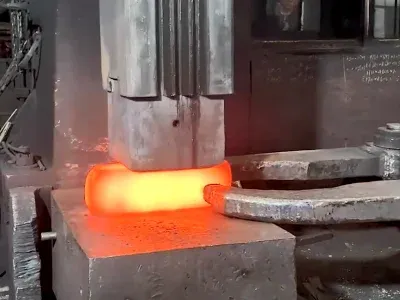
This is where the inverted logic bites hardest. Cold working followed by annealing recrystallizes — it refines grain size, because new strain-free nuclei form throughout the worked structure. To coarsen:
- keep strain low and work high in the single-phase field (no large stored energy, no recrystallization nucleation), then anneal so existing grains grow;
- or deliberately use strain-anneal / secondary recrystallization, where limited nucleation lets a few grains consume the rest at high temperature;
- never plan “cold work + anneal” when coarse grain is the target.
The Same Discipline Across Alloy Families
Grain control is not exclusive to nickel superalloys — every heat-treatable family manages it in its own temperature window: precipitation-hardening stainless like 17-7PH and 15-7PH balance solution, cold work and aging to set structure and strength; high-speed and hot-work tool steels like W18Cr4V and SKD61 (H13) control austenite grain size at austenitizing to trade toughness for wear resistance. The physics is the same: grain size is set by nucleation and pinning, and coarsening means removing nuclei and pinning particles while giving boundaries time to migrate.
FAQ
Q: Why are coarse grains wanted in high-temperature alloys? A: For creep resistance — fewer grain boundaries mean less boundary sliding and cavity nucleation under sustained high-temperature load.
Q: Are fine grains always better in high-temperature service? A: No. Fine grains improve low-temperature strength and fatigue initiation; coarse grains (and DS/SX) win creep duty. Selection follows the dominant load.
Q: Does overaging coarsen grain size? A: No. Overaging changes precipitate size and strength during aging; grain coarsening comes from high-temperature solution treatment above the solvus.
Q: Does cold work plus annealing produce coarse grains? A: Normally the opposite — cold work plus annealing recrystallizes to fine grains; coarse grains need low strain plus high-temperature anneal or controlled secondary recrystallization.
Q: What role do carbides and borides play in grain size? A: They pin grain boundaries (Zener pinning) and inhibit growth — so coarse-grain processing minimizes or dissolves them, while boron’s separate role is strengthening boundaries.
Q: How is coarse grain size achieved in cast superalloys? A: Slow solidification, low undercooling and removal of grain refiners and pinning species (low carbon, clean melt), then solution treatment above the solvus.
Ready to source grain-control grades and heat-treatable alloys? Contact Dura Alloy for 17-7PH, 15-7PH, W18Cr4V and SKD61 (H13) with full certification — nicholas.zhu1212@gmail.com · WhatsApp 8618921275456 · Request a quote