
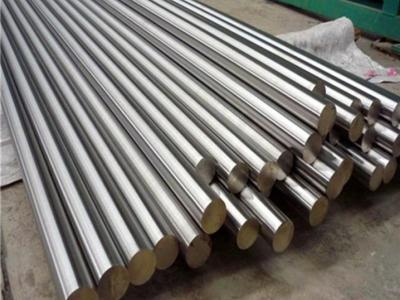
Descrição
Âmbito de fornecimento para o Aviation Group
Forjados, varões redondos, chapas de aço, anéis, tubos sem costura, chapas de aço/cintas de aço, materiais de soldadura de arame, bem-vindo ao inquérito!
1. Introduction to GH4049 Materials
GH4049 alloy is a Ni-Co-Cr-based precipitation hardened deformation high-temperature alloy, used at below 950 degrees Celsius. This alloy has good oxidation resistance below 1000 degrees Celsius and has a high high temperature strength below 950 degrees Celsius. Compared with nickel-based alloys of similar purposes, the alloy has poor thermal processing plasticity. It can improve its processing plasticity after electroslag remelting or vacuum arc remelting. This alloy is suitable for the manufacture of gas turbine blades with operating temperatures between 850-950°C.
Materials Technical Standards
GB/T14992 Classification and grade of high-temperature alloys and intermetallic compounds
GB/T14993 Specification for hot rolled rods for rotating components
GJB1953A Specification for hot rolled bars for high-temperature alloys for rotating parts of aircraft engines
HB/Z140 Aviation high-temperature alloy heat treatment process
2. Chemical composition of GH4049
| liga | % | C | Cr | Em | Al | De | V | W | Mo | Fe | cerium
Ce |
B | S | P | E | Mn |
| Gh4049/gh49 | Valor mínimo | – | 9.50 | margem | 3.7 | 1.4 | 0.200 | 5.0 | 4.5 | – | – | – | – | – | – | – |
| Valor máximo | 0.10 | 11.0 | 4.4 | 1.9 | 0.500 | 6.0 | 5.5 | 1.50 | 0.020 | 0.025 | 0.010 | 0.10 | 0.50 | 0.50 |
3. GH4049 physical properties
| densidade | g / cm3 | 8.44 |
| Ponto de fusão | ℃ | 1320-1390 |
| Magnetic performance | Alloy is non-magnetic |
Minimum value of mechanical properties of GH4049 alloy at room temperature:
| Estado da liga | resistência à tração | Resistência ao escoamento RP0,2 N/mm |
Alongamento | Dureza Brinell |
| Rm N/mm | A5 % | HB | ||
| Estado de fusão sólido | ≥570 | ≥275 | ≥8.0 | ≤363 |
4. GH4049 application fields
GH4049 is suitable for gas turbine working blades with operating temperatures of 850-950℃, and this is the most widely used.
Used to manufacture aircraft engine turbine blades and other high-temperature bearing workpieces.
Forgings can be used to manufacture structural parts for marine gas engines and military equipment.

 Portuguese
  English
  German
  French
  Japanese
  Russian
  Italian
  Spanish
  Arabic
  Korean