
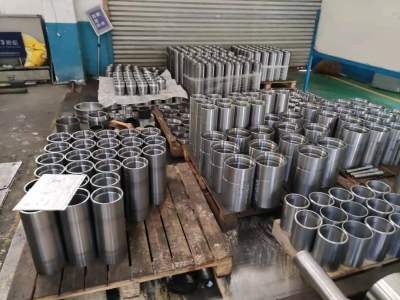
Descrizione
1. Introduction to Hastelloy C-4 Materials
HastelloyC-4 (N06455) Hastelloy alloy is an austenitic low-carbon nickel-molybdenum-chromium alloy. The main differences between Nicrofer6616hMo and other alloys with similar chemical compositions developed in the early stage are low carbon, silicon, iron, and tungsten content. Such chemical compositions make it exhibit excellent stability at 650-1040°C, improve the ability to resist intergranular corrosion, and avoid edge corrosion sensitivity and weld heat-affected corrosion in the appropriate manufacturing conditions.
2. Chemical composition of Hastelloy C-4
| lega | In | Cr | Fe | C | Mn | E | Mo | Co | Di | P | S | |
| Hastelloy C-4 | Valore minimo | margine | 14.5 | – | – | - | – | 14.0 | – | – | – | – |
| Valore massimo | 17.5 | 3.0 | 0.009 | 1.0 | 0.05 | 17.0 | 2.0 | 0.7 | 0.020 | 0.010 |
3. Hastelloy C-4 physical properties
| densità | 8.94g/cm3 |
| Punto di fusione | 1325-1370 ℃ |
Valore minimo delle proprietà meccaniche delle leghe a temperatura ambiente:
| Stato | Resistenza alla trazione Rm N/mm | Resistenza allo snervamento RP0,2 N/mm | Allungamento A5 % |
| Stato di fusione solido | 650 | 280 | 40 |
4. Hastelloy C-4 physical properties
- It has excellent corrosion resistance to most corrosive media, especially in reduced state.
- It has excellent local corrosion resistance in halides.
- Welding performance: hastelloy C-4 can be welded using various welding processes, such as tungsten electrode inert gas protection welding, plasma arc welding, manual sub-arc welding, metal extremely inert gas protection welding, and melt extremely inert gas protection welding. Priority is given to pulse arc welding.
Before welding, the material must be in an annealed state to remove the scale, oil and various mark marks. The two sides of the weld must be polished to a bright metal surface. Low heat input is used, and the temperature between layers does not exceed 150℃.
Metallographic structure: HastelloyC-4 is a face-centered cubic lattice structure, and its chemical composition ensures metallographic stability and anti-sensitization.
5. Hastelloy C-4 corrosion resistance
Higher molybdenum and chromium content enables HastelloyC-4 alloy to resist the erosion of various chemical media, including reducing media such as phosphoric acid, hydrochloric acid, sulfuric acid, chlorine, organic or inorganic chlorine-containing media. Due to the high nickel content, HastelloyC-4 can effectively resist stress corrosion and cracking caused by chlorine, and even hot chloride solutions.
