
Beschreibung
Lieferumfang für Aviation Group
Schmiedestücke, Rundstangen, Stahlplatten, Ringe, nahtlose Rohre, Stahlplatten/Stahlbänder, Kapillaren, Drahtschweißmaterial, bitte fragen Sie uns an!
Schmiedeteile aus Titan. Benutzerdefiniert
Titanstäbe gemäß den Zeichnungen. Φ(8-400) ×L≤5000mm (gewalzte Stäbe, geschmiedete Stäbe)
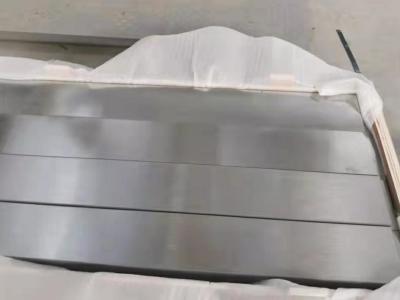
Titanblech/-band (0,3-60,0) × (400-1000) × (1000-3500) mm (kaltgewalztes Blech, warmgewalztes Blech)
Titan-Rohr Φ(3-210) × (0,2-10,0) ×L (gewalzte Rohre, extrudierte Rohre)
Titanring Außendurchmesser φ(100-1200) × Innendurchmesser Φ(100-1000) × Höhe (20-800) mm
Titan-Rundkuchen Φ(150-1200) × (20-800) mm
Titandraht Φ(0,1-7,0) ×L
- Introduction to Ti-6Al-4V materials
The composition of TC4 material of titanium alloy is Ti-6Al-4V, which belongs to the (α+β) type titanium alloy. TC4 titanium alloy is an alloy composed of titanium-based aluminum and vanadium. It has the advantages of low density, high specific strength, good corrosion resistance and good process performance, and has good comprehensive mechanical properties. It is an ideal structural material for aerospace engineering. Higher strength. The strength of TC4 is sb=1.012GPa, the density g=4.51g/cm3, the specific strength of sb/g=23.5, while the specific strength of alloy steel is less than 18.
- Ti-6Al-4Vchemische Zusammensetzung
| Markennummer | Chemische Zusammensetzung (Gewichtsprozent) | |||||||||||
| Chemicai Zusammensetzung(WT%) | ||||||||||||
| Ti-6al-4V | Chemische Inhaltsstoffe | Titan | Eisen | Kohlenstoff | Stickstoff | Wasserstoff | Sauerstoff | Aluminium | Vanadium | Andere Verunreinigungen | ||
| (Of) | (Fe) | (C) | (N) | (H) | (O) | (Al) | (V) | einzeln | Summe | |||
| Industrielles Reintitan | Marge | ≤0.30 | ≤0.10 | ≤0.05 | ≤0.015 | ≤0.25 | 5.5~6.8 | 3.5~4.5 | ≤0.10 | ≤0.40 | ||
- Ti-6Al-4Vphysikalische Eigenschaften
Ti-6Al-4V titanium alloy density: 4.5 (g/cm3) working temperature -100~550 (℃)
| Markennummer | Room temperature mechanical properties are not less than | High temperature mechanical properties are no less than | ||||||
| Tensile strength σb MPa | Yield strength σ0.2MPa | Elongation δ5% | Shrinkage ψ % | Impact value αk J/cm 2 | Test temperature ℃ | Tensile strength σb MPa | Long-lasting strength σ100 MPa | |
| TC1 | 588 | — | 15 | 30 | 44.1 | 350 | 343 | 324 |
| TC2 | 686 | — | 12 | 30 | 39.2 | 350 | 422 | 392 |
| Ti-6al-4V | 902 | 824 | 10 | 30 | 39.2 | 400 | 618 | 569 |
| TC6 | 981 | — | 10 | 23 | 29.4 | 400 | 736 | 667 |
| TC9 | 1059 | — | 9 | 25 | 29.4 | 500 | 785 | 588 |
| TC10 | 1030 | — | 12 | 25~30 | 34.3 | 400 | 834 | 785 |
| TC11 | 1030 | — | 10 | 30 | 29.4 | 500 | 686 | 588 |
- Technical standards of Ti-6Al-4V materials
GB/T3620.1-2016 Titan und Titanlegierungen und deren chemische Zusammensetzungen
GB/T 3621-2007 ASTM/B265 Bleche aus Titan und Titanlegierungen
GB/T2965 -2007 ASTM/B348 Stabmaterial aus Titan und Titanlegierungen
GB/T 3624-2010 ASTM337 Nahtloses Rohr aus Titan und Titanlegierungen
GB/T16598-2013 Rohre aus Titan und Titanlegierungen für ASTM381-Wärmetauscher und -Kondensatoren
GB/T13810-1997 Werkstoffe zur Verarbeitung von Titan und Titanlegierungen für chirurgische Implantate AMST/F136
GB/T3623-2007 AMST/B863 Draht aus Titan und Titanlegierungen
AMST/B265 ASTM/B265 Titan und Titanlegierungen Band-Folie
Ti-6Al-4V heat treatment performance
The Ti-6Al-4V titanium alloy is heated to 1020 degrees, and the alloy’s high-temperature microstructure is composed of single-phase β, which is a solid solution. When the microstructures obtained are different at different cooling rates, such as water quenching, air cooling and furnace cooling, the microstructure obtained is different. The water quenching (WQ) structure is martensite α’+β phase, the air cooling (AC) structure is needle-shaped α+β phase and original β grain boundary phase, and the furnace cooling (FC) structure is strip-shaped α+β phase and original β phase grain boundary.
As in the above case, when heated to 950 degrees and 850 degrees, the microstructure obtained after cooling is also different after different cooling speeds. At 950 degrees, the quenched (WQ) tissue in water is the primary equiaxed α phase and α’+β phase, the air-cooled (AC) tissue is the primary equiaxed α phase and the needle-shaped β phase, and the furnace-cooled (FC) tissue is the primary equiaxed α phase and the grain boundary. At 850 degrees, the quenched (WQ) tissue in water is the primary equiaxed α phase and the metastable β phase, and the air-cooled (AC) tissue is the primary equiaxed α phase and the transformed β phase.
After heating Ti-6Al-4V titanium alloy to 1020 degrees, 950 degrees and 850 degrees, it cools at different cooling speeds. The room temperature mechanical properties are shown in Table 1
| Heating temperature and cooling method | Tensile strength/Mpa | Dehnung/% | Surface shrinkage rate/% |
| 1020 degrees Swimming (WQ) | 1098 | 6.0 | 8.0 |
| 1020 degree air cooling (AC) | 1005 | 9.0 | 13.5 |
| 1020 degrees furnace cooling (FC) | 960 | 12.0 | 22.5 |
| 950 degrees Swimming (WQ) | 1035 | 17.0 | 61.5 |
| 950 degree air cooling (AC) | 919 | 20.0 | 50.0 |
| 950 degree furnace cooling (FC) | 902 | 21.0 | 48.0 |
| 850 degrees Swimming (WQ) | 976 | 18.0 | 49.0 |
| 850 degree air cooling (AC) | 951 | 18.0 | 49.0 |
- Ti-6Al-4Vapplication field
- It is mainly used in aircraft compressor discs and blades, ship pressure-resistant shells, large-size forgings, die forgings, etc.;
- Used to manufacture rockets, missiles and aircraft structural parts, aircraft skeletons, skins, engine components, beams, etc.;
- Pipeline systems, valves, and pumps that are corroded by marine seawater;
- Power station condensers, accelerators for petroleum refining and seawater desalination, and environmental pollution control devices, etc.;
- Chemical heat exchanger, pump body, distillation tower;
- Widely used in medical devices

 German
  English
  French
  Portuguese
  Japanese
  Russian
  Italian
  Spanish
  Arabic
  Korean