
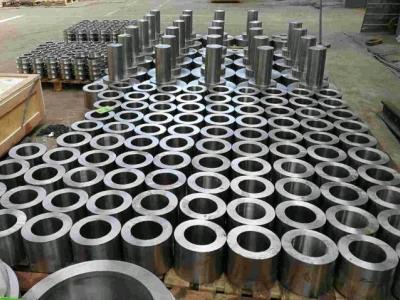
Beschreibung
Das Leistungsspektrum unseres Unternehmens umfasst
Nicht genormte Schmiedestücke, Rundstangen, Stahlplatten/Stahlbänder, Flanschrohre, nahtlose Rohre, Kapillaren, usw. Willkommen zu erkundigen!
1. Introduction to 309S materials
309S is a easily-cut stainless steel containing sulfur, which is used in occasions where easy cutting and high surface finish are mainly required. 309s is a variant of 309 stainless steel with a low carbon content and is used in situations where welding is required. Lower carbon content minimizes the precipitation of carbides in the heat-affected zone near the weld, and precipitation of carbides can cause intergranular corrosion (welding erosion) of stainless steel in certain environments.
Its high chromium content and nickel content ensure good corrosion resistance and oxidation resistance. Compared with the austenite 304 alloy, it is slightly stronger at room temperature.
2. 309S chemical composition
| Legierung | % | Chrom Cr | Kohlenstoff C | Mangan Mn | Silizium Si | Phosphor P | Schwefel S | Ni | Titan Ti |
| 309S | Minimaler Wert | 17.0 | – | – | – | – | – | 9.0 | 5*C% |
| Maximaler Wert | 19.0 | 0.08 | 2.00 | 1.00 | 0.035 | 0.030 | 12.0 | – |
3. 309S mechanical properties
Tensile strength σb (MPa): ≥520
Conditional yield strength σ0.2 (MPa): ≥205
Elongation δ5 (%): ≥40
Section shrinkage ψ (%): ≥50
Hardness: ≤187HB; ≤90HRB; ≤200HV
Heat treatment specifications and metallographic structure:
Heat treatment specifications: 1) Solid solution 920~1150℃ quickly cooled; 2) Stabilization treatment can be carried out according to the requirements of the demand party, and the heat treatment temperature is 850~930℃, but it must be noted in the contract.
Metallographic structure: The structure is characterized by austenite type.
Delivery status: Generally delivered in a heat treatment state, the type of heat treatment is indicated in the contract; if not specified, the delivery shall be carried out in a heat treatment state.
4. 309S application field
Widely used in important fields such as boilers, energy (nuclear power, thermal power, fuel cells), industrial furnaces, incinerators, heating furnaces, chemicals, petrochemicals and other important fields.

 German
  English
  French
  Portuguese
  Japanese
  Russian
  Italian
  Spanish
  Arabic
  Korean